One Health

Students and staff on campus

Welcome to OneHealth@AdelaideUniversity

OneHealth@AdelaideUniversity (OH@AU) will unite expertise across all disciplines through a transdisciplinary and intersectoral approach to address complex and emerging challenges spanning the health of humans, animals and the environment.  

Our vision is for a healthy, resilient world for all living things and their environments. 

Our mission is to promote and advance impactful education, research, and practical applications in the field of One Health. 

Resources

Resources are available for collaboration in the One Health space.

Engage with us

Contact us for general enquiries, business development and partnering opportunities.

Who are we?

OH@AU follows the definition of One Health provided by the One Health High-Level Expert Panel (OHHLEP, 2024)  

“One Health is an integrated, unifying approach that aims to sustainably balance and optimize the health of people, animals and ecosystems. It recognizes the health of humans, domestic and wild animals, plants, and the wider environment (including ecosystems) are closely linked and inter-dependent.”

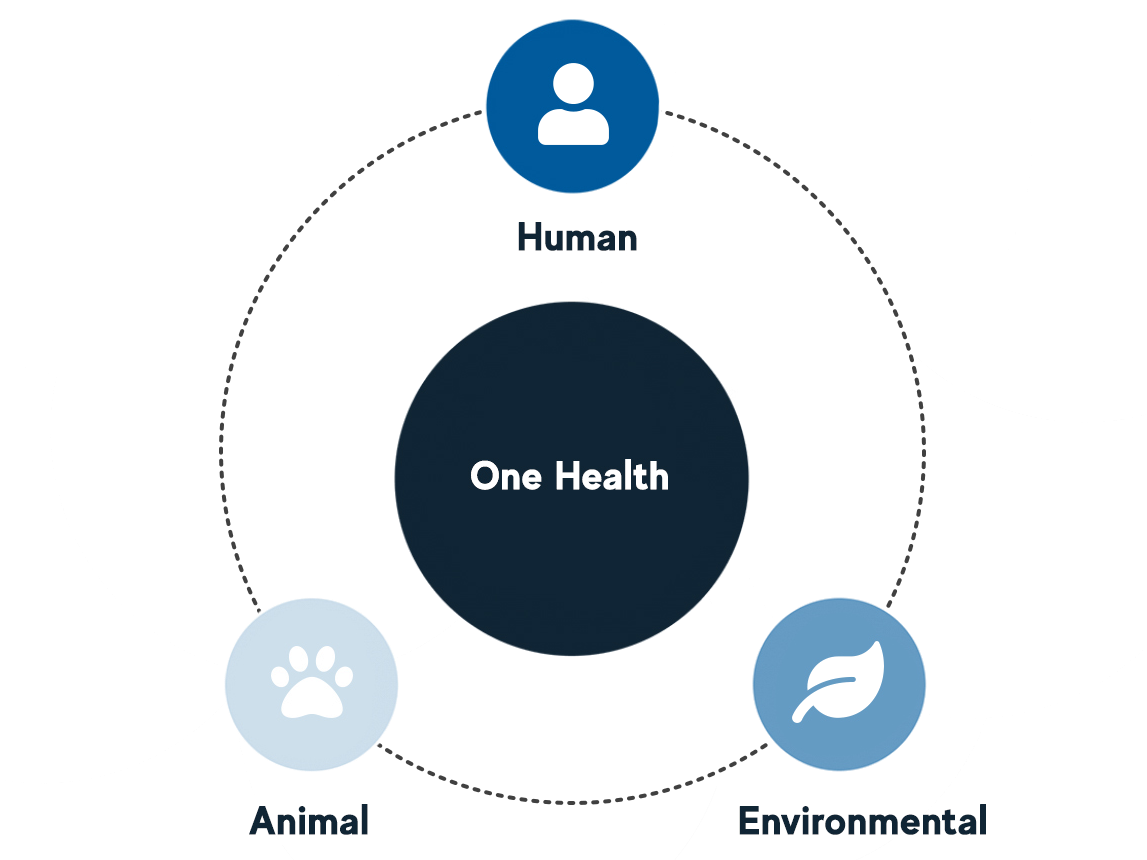
One Health is the interconnection of human, animal and environmental health. 

Our One Health principles 

Network ideas map icon

Interconnectedness of human, animal, and environmental health, recognising that problems in one area can have consequences for the others. 

Team icon

Transdisciplinary approach involving experts from various fields, including public health, veterinary medicine, environmental sciences and more.

Speech bubbles icon

Effective collaboration and communication among different sectors and stakeholders, including governments, researchers, industry, and the public.

Recycle icon

Sustainable solutions that benefit human, animal, and environmental health in the long term.

Explore OneHealth@AdelaideUniversity

Our role is to coordinate, promote, and facilitate One Health activities in collaboration with stakeholders.

OH@AU will:

  • Provide a forum for discussion, activities and events on One Health 
  • Foster a collaborative and transdisciplinary approach 
  • Engage with Government and industry partners to identify projects and opportunities to collaborate 
  • Generate research by identifying knowledge gaps 
  • Encourage community engagement and awareness 
  • Build capacity in research, grant, and career development 
  • Encourage and support opportunities for cross disciplinary teaching, and promote education on One Health matters and related topics 
  • Generate and promote evidence-based knowledge to facilitate practical changes for industry, policymakers, researchers, educators and communities. 
A diagram showing One Health is the intersection of human health, animal health, and environmental health.

Leads

Dr Adriana Milazzo

OneHealth Collaborative Lead

Infectious disease epidemiology, climate change and population health, and One Health.

Adriana Milazzo

Professor Michael Beard

OneHealth Collaborative Lead

Molecular virology and cellular interactions of positive sense RNA viruses.

Micheal Beard

Dr Anne-Lise Chaber

OneHealth Collaborative Lead

One Health and disease detection and management at the wildlife-livestock-human interface. Currently working at the WHO Organisation as a One Health Expert.

Anne-Lise Chaber

The One Health team


Isabell Schuster 
OneHealth Project Officer 

Steering Committee members oversee the operational direction of OH@AU. 

Associate Professor Barbara Drigo  
Microbial ecology, antimicrobial resistance, wastewater-based epidemiology, plant-soil-microbial interactions, climate change. 

Carmel Williams 
Director of the Centre for HiAP Research Translation, Co- Director of the World Health Organization Collaborating Centre for Advancing Health in All Policies. 

Professor Craig Williams
Biological, Environmental, Medical and Health Sciences, Ecosystems, Zoology, microbiology, vector-borne disease (STEM) 

Dr Laura Falkenberg  
Marine Biologist and Ecologist investigating the impacts of human activities on coastal marine organisms, their ecosystems and services to human societies 

Dr Mark Kohler
Psychologist focussing on Cognitive and Behavioural development and Psychophysiology.

Dr Mira Cooper  
Environmental health researcher investigating environmental impact on human health with the One Health approach. 

Professor Patrick O'Connor AM
Director, Centre for Global Food and Resources. Research interests include Ecosystem service markets, agro-ecosystems focusing on health and biodiversity.

Associate Professor Rietie Venter 
Microbiology, AMR, Biochemistry and Cell Biology, Pharmacology and Pharmaceutical Sciences, Medical Microbiology. 

Associate Professor Wayne Boardman
Conservation of endangered species, emerging wildlife diseases, wildlife disease ecology, health and diseases of Australian native wildlife. 
Members of the Advisory Committee provide governance and strategic oversight. 

Dr Mira Cooper  
Environmental health researcher investigating environmental impact on human health with the One Health approach. 

Professor Patrick O'Connor AM
Director, Centre for Global Food and Resources. Research interests include Ecosystem service markets, agro-ecosystems focusing on health and biodiversity.

Associate Professor Rietie Venter
Microbiology, AMR, Biochemistry and Cell Biology, Pharmacology and Pharmaceutical Sciences, Medical Microbiology. 

Associate Professor Wayne Boardman
Conservation of endangered species, emerging wildlife diseases, wildlife disease ecology, health and diseases of Australian native wildlife. 

Professor Peng Bi 
Environmental health, climate change, infectious diseases, emergency public health event response and population health 

Professor Andy Lowe
Director, Environment Institute. Specialises in Plant ecology and Evolutionary Genetics 

Professor Fran Baum AO
A Public Health social scientist with a special interest in creating healthy, equitable and sustainable societies. 

Aleena Iype 
Researching the complex intersections between wildlife trade, emerging infectious diseases, and biosecurity risks to inform national biosecurity frameworks and protocols. 

Toby Hughes
Researching early life factors that influence health and development throughout childhood and early adult life, specifically in interactions between the genome, the epigenome, the environment and the commensal bacteria (the microbiome). 

Dr Jessica Webb
Pathogen genomics, One health genomics, genomic epidemiology, computational microbiology, bioinformatics 

Harmful Algal Blooms (HAB) in South Australia 

Adelaide University in partnership PIRSA-SARDI has a network of experts undertaking research and providing guidance to the State Government's inquiry and ongoing work to mitigate the effects of the HAB. The team are supporting efforts to monitor the bloom, support the environment and marine life, and assisting the communities affected by this devastating event. 

For the latest information please visit the South Australian Government’s algal bloom website.  

People relaxing at Glenelg beach on a sunny day

One Health publications

One Health implementation: A systematic scoping review using the Quadripartite One Health Joint Plan of Action - ScienceDirect  (Adriana Milazzo, Jingwen Liu, Priyanka Multani, Sandra Steele, Elizabeth Hoon, Anne-Lise Chaber)

Williams, CR. et al. (2025). Submission from the NH&MRC Healthy Environments and Lives SA Regional Hub to the Senate Inquiry on Toxic Algal Blooms in South Australia. Adelaide, South Australia. Submissions – Parliament of Australia, Submission #43.

Lowe, A. et al. (2025). Submission from the Environment Institute, The University of Adelaide to the Senate Inquiry on Toxic Algal Blooms in South Australia. Submissions – Parliament of Australia, Submission #40.

Keneally, C. (2025). Submission, The University of Adelaide to the Senate Inquiry on Toxic Algal Blooms in South Australia. Submissions – Parliament of Australia, Submission #29.

Rammage, J. (2025). Submission, UniSA STEM to the Senate Inquiry on Toxic Algal Blooms in South Australia. Submissions – Parliament of Australia, Submission #121.

Lefrançois, T. et al. (2025).  A new definition of human health is needed to better implement One Health , The Lancet, Volume 406, Issue 10504, 672-675, https://doi.org/10.1016/S0140-6736(25)01015-3 .

Roger, F., Olive, M., Peyre, M., Pfeiffer, D., & Zinsstag, J. (2025). One Health Atlas . In éditions Quae eBooks. https://doi.org/10.35690/978-2-7592-4027-2 

Winkler, Andrea S et al. (2025). The Lancet One Health Commission: harnessing our interconnectedness for equitable, sustainable, and healthy socioecological systems . The Lancet, Volume 406, Issue 10502, 501 – 570, https://doi.org/10.1016/S0140-6736(25)00627-0 

Sukumar, S. et al. (2023). Development of the oral resistome during the first decade of life . Nature Communications, 14(1), 1291-1-1291-14.

Espinoza, J.et al. (2022). Differential network analysis of oral microbiome metatranscriptomes identifies community scale metabolic restructuring in dental caries . PNAS Nexus, 1(5), pgac239-1-pgac239-16.

Freire, M., Moustafa, A., Harkins, D., Torralba, M., Zhang, Y., Leong, P., . . . Nelson, K. (2020). Longitudinal study of oral microbiome variation in twins . Scientific Reports, 10(1), 7954-1-7954-10.

Why One Health matters 

No matter where you work, One Health principles are relevant. In today’s interconnected world, environmental stewardship and sustainability are essential priorities for every organisation and all communities.  

We are all connected and can all contribute to creating a healthy, resilient world for all living things and our environment. 


Considering a future in One Health?  Get to know these One Health experts and see where it could lead.  

Visit the Green Adelaide website to meet Coastal Conservation Officer, Matt Endacott.  

Episode 19 of the Green Adelaide podcast profiles some interesting career pathways, visit the Green Adelaide website to tune in.  

Read about One Health Flagship Lead at the WHO, Dr Anne-Lise Chaber

Visit the websites listed below to find current opportunities available in One Health.

To advertise a role, email onehealth@adelaide.edu.au.

Volunteer opportunties

Opportunities from One Health aligned organisations and from researchers looking for volunteers will be advertised here. Keep an eye out here for volunteer opportunities in 2026. 

In the meantime, you might be interested in the following opportunities from South Australian organisations.  

Visit the Volunteer webpage to find volunteering opportunities within Adelaide University.  

Environmental health

Animal health

  • Zoos SA seek volunteers for opportunities across Adelaide Zoo and Monarto Safari Park.  
  • RSPCA need volunteers in animal care, foster care and animal rescue.  
  • Animal Welfare League require volunteers to support their efforts caring for animals.  

Human health

Resources

One Health’s keystone works across different disciplines, industry sectors and organisations to capture the complexity and interconnectedness of issues. Resources are available for collaboration in the space.


Contact OH@AU 

For general enquiries, business development and partnering opportunities, you can contact us by:

Email

Email: onehealth@adelaide.edu.au

Email

Phone: +61 0404 740 080