Our facilities

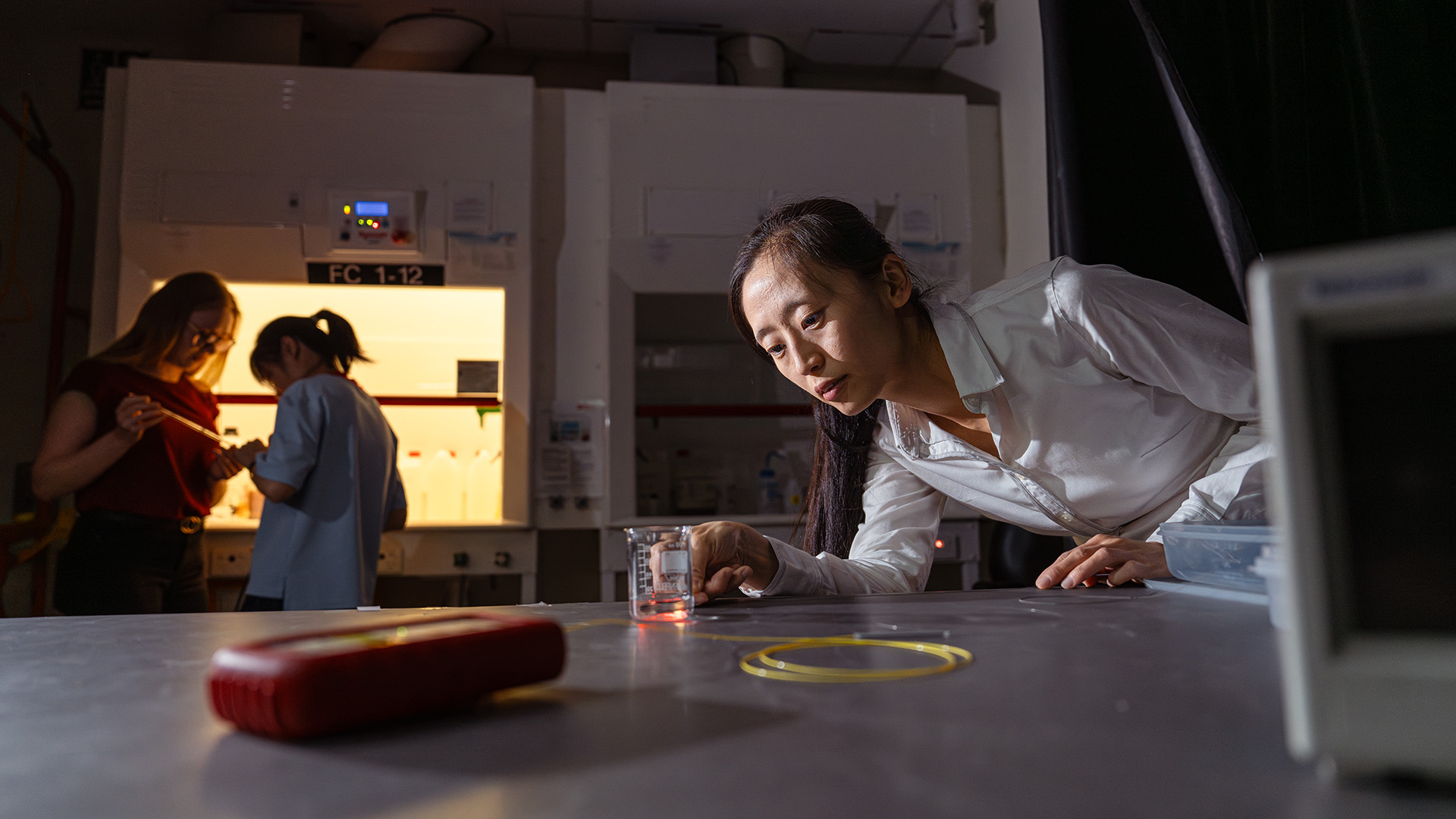
IPAS researcher in the Li Jiawen lab

Explore our facilities at IPAS

From cutting-edge laboratories to highly specialised fabrication and analytical capabilities, the Institute for Photonics and Advanced Sensing provides the infrastructure and expertise that make it a leading hub for advanced light-based research in Australia and beyond.

The Braggs Building – Our Principal Hub

Named after Nobel Laureates Sir William and Sir Lawrence Bragg, the Braggs Building is the beating heart of IPAS. It houses our core laboratory facilities and offices, serving as a collaborative centre where researchers, students, and industry partners innovate together.


Our Laboratories

Our diverse labs support transdisciplinary research, combining fundamental ‘blue-sky’ photonics with applied projects developed in close collaboration with industry and ready for commercialisation, including state-of-the-art laboratories and equipment in purpose-built facilities. The following are examples of our labs – many more exist across IPAS:

  • Precision Measurement (PMG) – Developing instruments capable of world-class precision and accuracy, enabling cutting-edge photonics measurements.
  • Prescott Environmental Luminescence (PELL) – Specialised in ‘Novel Fluorescence’ and radiation science, enabling non-contact material identification, dosimetry, geochronology, and high-resolution mapping of radioisotopes.
  • Photonics Materials – Synthesis, development, and characterisation of novel optical and photonic materials – including world leading optical fibre manufacturing facilities.
  • Laser Fabrication and Development Facilities – From diode manufacturing in the Quantum Materials Labs to chip and fibre lasers exploiting single and multimode photonics, driving the next generation of sensors, lasers, and photonics devices.
  • Quantum Materials – Development and characterisation of semiconductor and superconductor-based quantum devices, including proof-of-concept system creation.
  • Centre of Light for Life (CLL) – Translational quantum photonics research with applications in biology, medicine, agriculture, and healthcare.
  • Terahertz Engineering Labs – Modular terahertz systems supporting advanced research and future integrated THz technologies, succeeding bulky ultrafast-laser setups.
ANFF OptoFab Adelaide – Fabrication Facility

The OptoFab Adelaide Hub, part of the Australian National Fabrication Facility (ANFF) OptoFab Node, specialises in photonics materials. This facility combines state-of-the-art equipment with highly skilled staff who provide technical support for the fabrication of fibre, planar, and bulk optical materials, including silica, silicon, lithium niobate, and polymers. Post-processing capabilities such as surface functionalisation and advanced characterisation enable unique artefacts for applications in telecommunications, biotechnology, medicine, microelectronics, optical sensing, industrial processing, and defence.

Key capabilities include:

  • Soft glass batching, melting, casting, and preform extrusion
  • Optical fibre drawing for core-clad and microstructured fibres
  • Development of fibres for lasers, telecommunications, sensing, and biomedical applications

This facility enables research that would be impossible without it, and supports industry-linked development and high-impact photonics innovation.

Metrology and analytical capabilities

IPAS offers state-of-the-art testing, validation, and characterisation capabilities, supporting precise measurements across materials, optics, and molecular systems:

  • Chemical Analysis – High-performance liquid chromatography and spectroscopic methods for material characterisation.
  • High-Throughput Screening – Plate readers for rapid biological and chemical assays.
  • Dimensional Metrology – Camera and touch-probe coordinate measurement for precise geometry mapping.
  • Thermal Analysis – Simultaneous thermal analysis and dilatometry for material stability and expansion studies.
  • Surface Profiling – 3D optical metrology for accurate surface characterisation.
  • Optical Spectroscopy – UV-Vis-NIR and ellipsometry for optical and thin-film properties.
  • Molecular Characterisation – FTIR for chemical composition and molecular structure analysis.

Engage with us

Explore partnership opportunities with IPAS to transform ideas into real-world solutions. Our state-of-the-art facilities support prototyping and testing and our deep connections with industry, government, and academia foster discovery, innovation and translation.

Contact us

Institute for Photonics and Advanced Sensing

Location

Location
Institute for Photonics and Advanced Sensing
Adelaide University
Level 1, The Braggs Building, City Campus East, Adelaide SA 5000

Telephone

Phone: +61 8 8313 9211

Email

Email: ipasadelaide@adelaide.edu.au