
A new discovery by researchers from Adelaide University, in collaboration with Denmark’s Carlsberg Research Laboratory, will allow barley growers to optimise seed dormancy for their crops and improve growing efficiency.
The researchers employed a multidisciplinary approach to construct the barley mitogen-activated protein kinase (MAPK) enzyme-substrate complex, which plays a crucial role in seed dormancy.
“It was exciting to construct the MKK3/MAPK enzyme-substrate complexes using the tools of chemistry, biochemistry, biophysics, structural biology, genetics, and bioinformatics,” said co-author Professor Maria Hrmova, from Adelaide University.
“This structural model we’ve identified could impact plant breeding and food production, such as by plant breeders optimising the period of grain dormancy while avoiding undesirable pre-harvest sprouting, where the grain germinates before harvest.”
Study co-author Professor Geoff Fincher, also from Adelaide University, said the research has facilitated several advances in knowledge about seed dormancy.
“We discovered the mechanisms through computational protein-protein docking, and defined the hydrolysis of the ATP substrate, and the transfer of a phosphate group to the downstream MAPK enzyme that resulted in its activation,” said Professor Fincher.
“The work also clarified evolutionary aspects of natural and anthropogenic selection that have regulated the seed dormancy to germination transition under different environmental and commercial conditions.”
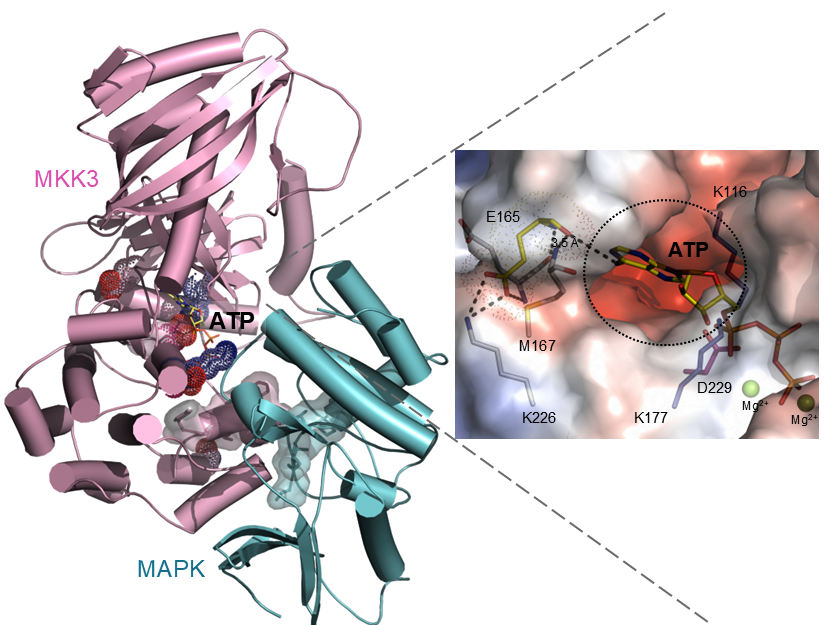 The 3D model of the barley MKK3/MAPK enzyme-substrate complex illustrates the geometry of the ATP binding site, buried within the active site of MKK3. Credit: Maria Hrmova.
The discovery, which was published in the International Journal of Molecular Sciences, builds on existing knowledge of the genetic underpinnings of seed dormancy in barley.
“Genetic analyses have previously revealed two dormancy loci in barley that encode an alanine aminotransferase enzyme and a MAPK kinase, MKK3, which forms one part of a three-component MAPK module or cascade,” said Professor Hrmova.
Professor Hrmova said the discovery could have impacts for a range of other crops, such as rice.
“Our work will impact pangenome-informed plant pre-breeding using resources associated with multiple genetic variants to define combinational effects of variations on protein structure and function,” she said.
“This will facilitate future manipulations of plant dormancy length in different environments.”