
WOMADelaide’s Bat Tent returns for its seventh edition this year, with Adelaide University researchers attending to share their knowledge of and affection for Botanic Park’s resident flying foxes.
Associate Professor Wayne Boardman, who started the initiative in 2019, says visitation to the Bat Tent has increased since its inaugural year.
“We see thousands of visitors each year, who come with questions inspired by the camp of flying foxes that greet festival goers with their cackles as they enter the event,” Associate Professor Boardman said.
“The flying fox camp at Botanic Park consists of around 40,000 individuals – approximately six per cent of the world’s population – so the interest in the highly active group is not surprising.
“We want to help visitors appreciate this unique opportunity to observe the wondrous antics of the flying foxes – less than one kilometre from the centre of Adelaide.”
Bat experts provide binoculars to Bat Tent visitors to allow them a closer look while explaining the vital role the creatures play in their environment.
“Flying foxes aren’t often thought of as pollinators, but they provide invaluable ecosystem services, such as long-distance pollination and seed dispersal,” Associate Professor Boardman said.
“We are keen to impress upon people that without flying foxes, we would not have koalas, as the bat helped expand where the eucalyptus trees koalas feed on are found.”
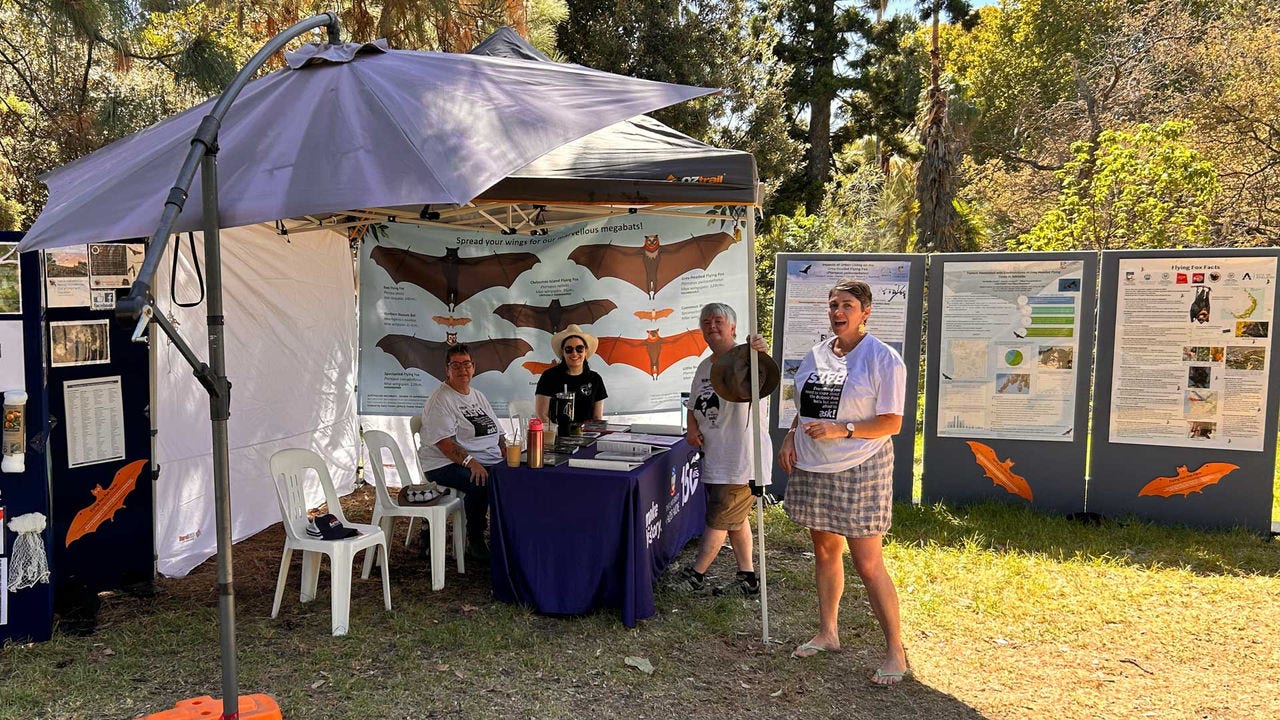 Experts ready to answer your flying fox questions.
Associate Professor Boardman said the fact WOMADelaide, which held its inaugural event at Botanic Park in 1992, pre-dates the flying fox population surprises most attendees.
“Flying foxes were not here before 2010, so they have only made Adelaide their home relatively recently,” said Associate Professor Boardman, who recently received the Australian Veterinary Conservation Biology Group’s Tony English Award recognising outstanding lifetime contributions to veterinary conservation biology.
“We are not sure why they arrived, whether it was a ‘push’ associated with poor food resources in Victoria and NSW or the ‘pull’ of an untapped food source in Adelaide complemented by introduced plant species since European times.
“Maybe we have provided them with a native and exotic smorgasbord of food resources that they just could not refuse.”
In addition to the Adelaide population, there are flying foxes present in Kuitpo, Mount Crawford, Naracoorte, Mount Gambier and Port Pirie.
“Flying foxes’ recent appearance here makes education all the more important – it’s always nice to get to know your neighbours,” Professor Boardman said.
The Bat Tent will be open from 6-9pm on Friday and 1pm-9pm on Saturday, Sunday and Monday, located near Stage 7.