Australian Rover Challenge

Australian Rover Challenge

Australian Rover Challenge

EXTERRES Analogue Facility

Roseworthy Campus / South Australia

Date

Australian Rover Challenge 2026 Dates

Thursday 26th March to Sunday 29th March, 2026

Roseworthy Campus, South Australia

Date

About

Space and lunar research

For

Domestic and international students
STEM students
Postgraduate research students

About the competition

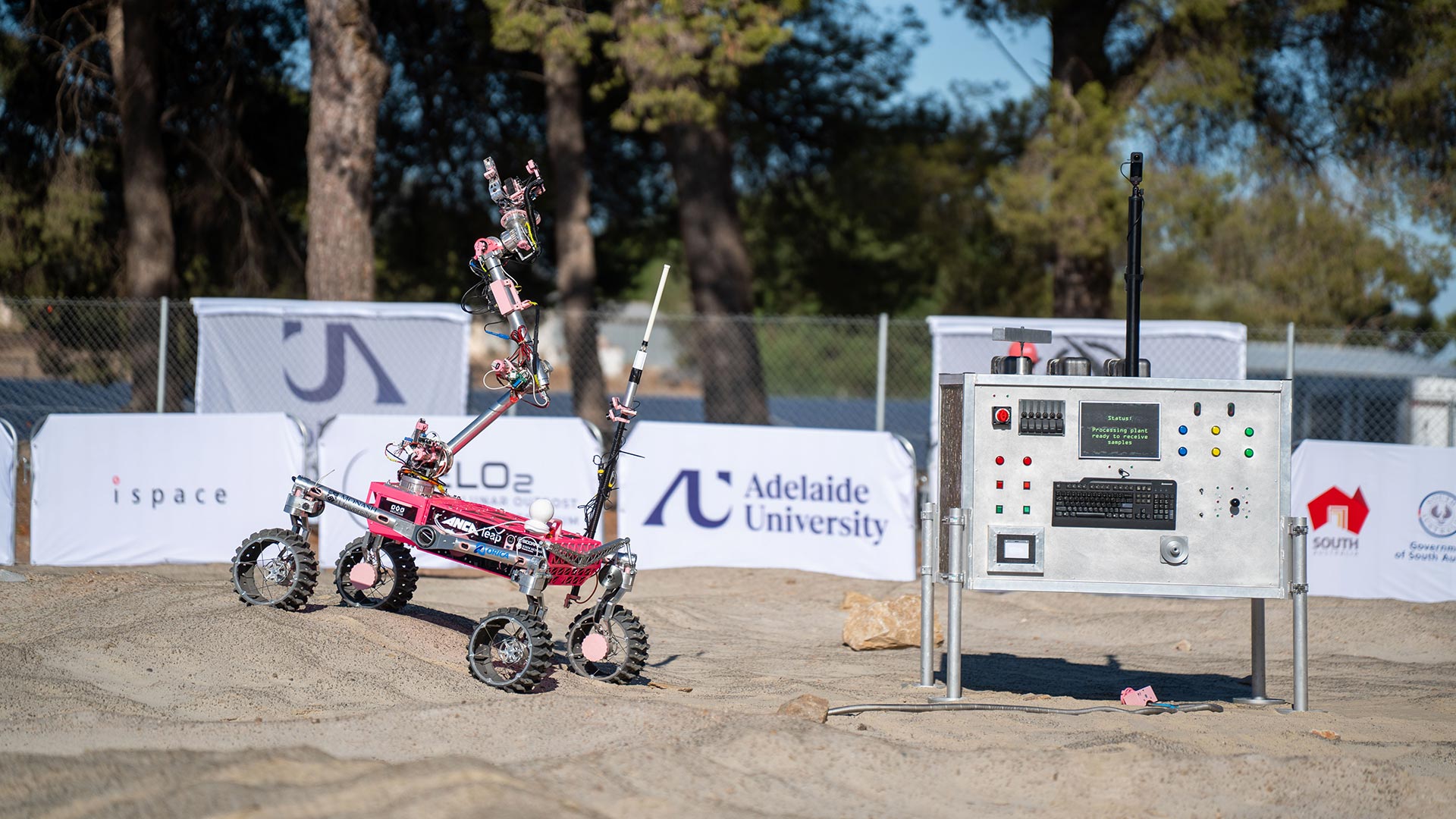
Our aim is to challenge students to demonstrate a fully-functional foundation services rover capable of remote operation, autonomy, manipulation and ISRU, in line with Australia’s commitment to support NASA’s Moon to Mars program through the Trailblazer mission.

Inspiring the next generation space workforce

The Australian Rover Challenge aims to address the four Strategic Space Pillars outlined in the Australian Space Agency 2019 - 2028 Civil Space Strategy by inspiring the next generation of the Australian space workforce to learn-by-doing through a hands-on simulated mission to the Moon and Mars.

The Australian Rover Challenge showcases Australian student talent and technological capability in space activities. The primary goals and vision of the Australian Rover Challenge are to:

  • Create new university student teams by providing a platform for new, multidisciplinary robotics groups to grow across Australia and to compete in simulated mission-based scenarios for planetary rovers.
  • Engage with industry by directly partnering with business within the Australian space industry to create a pipeline for student employment and to discuss unique opportunities and innovative solutions in space technology and science.
  • Grow the Australian space industry by establishing and fostering collaboration between Australian tertiary education institutions, Australian and international industry, and special interest groups with a focus on space exploration, robotics, planetary resources, autonomy and remote communications.
  • Support Australian space research by providing an opportunity for undergraduate and post-graduate research on robotics, space resources, communications and autonomy to be showcased under simulated mission conditions.
About the competition
2026 key dates
20 August 2025Rules and requirements released, team registration opens
4 September 2025Critical Design Review (CDR) released
17 September 2025Team registration closes
29 October 2025CDR due. System Acceptance Review (SAR) and Cost Report Guidelines released
11 February 2026SAR and video due
11 March 2026Cost report due
25 March 2026Australian Rover Challenge opening ceremony
26 March 2026Australian Rover Challenge competition commences
29 March 20262026 Australian Rover Challenge competition concludes

Dates may be adjusted at the discretion of the judges. In this case, an announcement will be made to all registered teams in advance, and a new version of this document with updated dates will be published.

Venue Information

Attend the Australian Rover Challenge

The Australian Rover Challenge 2026 will take place from Thursday 26 March - Sunday 29 March at the EXTERRES facility at the University of Adelaide Roseworthy Campus.

The drive from Adelaide CBD to Roseworthy Campus is approximately 45 - 60 minutes depending on the time of day and traffic conditions. Enter from Mudla Wirra Road, turning into Philip Drive. There is ample free parking in close proximity to the Challenge Arena.

More information for spectators will become available closer to the event date. 

Information for teams

John Culton, Director of the Andy Thomas Centre for Space Resources, welcomes all students and teams who are participating in the Australian Rover Challenge.

Welcome! On behalf of the Andy Thomas Centre for Space Resources, I am pleased to welcome you to the Australian Rover Challenge.

While the ultimate focus of our Centre is to support long-term human presence beyond low-earth orbit, we know that our astronauts will necessarily be preceded, and then accompanied by, significant numbers and varied types of remotely operated or semi-autonomous robots.

Thus, initiatives to further develop an Australian competency in this sector align perfectly with our Centre’s mission.

We are endeavouring to deliver a highly rewarding and globally unique challenge series. Importantly, the skill sets developed in support of this challenge are becoming increasingly relevant as efforts to develop infrastructure required to support long-duration human operations in deep space steadily gain support from programs such as NASA’s Artemis. Once again, welcome to Adelaide and the Australian Rover Challenge. We are looking forward to seeing what you and your rovers can accomplish.

The 2026 ARCh will run from Thursday 26th – Sunday 29th March 2026, at the University of Adelaide Roseworthy Campus.

This is the second time the Australian Rover Challenge has been held at the Roseworthy Campus. To help navigate your way out to Roseworthy, and to assist you in planning your visit and stay here in Adelaide, we have gathered some useful links and information.

A/Prof John Culton A/Prof John Culton | Director, Andy Thomas Centre for Space Resources

Adelaide, the capital city of South Australia, is one of the worlds’ most liveable cities. Its vibrant and charming destination offers a unique blend of natural beauty, cultural experiences, and a relaxed lifestyle, and is home to the Australian Space Agency.

Wanting to know more about Adelaide? Visit the South Australian Tourism Commission or Experience Adelaide websites for further information on what to see and do while you're in Adelaide.

Adelaide University’s purpose-built course this year is at the University’s Roseworthy Campus, approximately 60kms north of the city centre, Mudla Wirra Rd, Roseworthy.

The Roseworthy campus is the major centre for South Australia’s animal and veterinary science research and teaching and home to the new Exterres Analogue Facility.

There are several options for transportation to and from Adelaide University’s Roseworthy Campus, either from the Adelaide CBD, or Gawler City Centre.

By car

From the Adelaide CBD the drive is approximately 45 – 60 minutes depending on the time of the day and traffic conditions.

From Gawler the drive is approximately 15 - 25 minutes depending on the time of the day and traffic conditions.

There are several rental car companies in Adelaide. Some companies have small buses and people movers in their fleet.

There is ample free parking on site close (approximately 5-minute walk) to the competition site.

There will be a dedicated unloading zone in the competition vicinity for each team.

By train 

The train from the Adelaide Railway Station to Gawler Central Railway Station (train service GAWC) takes about an hour. You will still then need to make your way to Roseworthy Campus.

Fares can be purchased using the Adelaide Metro tap and pay onboard validators with a Visa or Mastercard (credit/debit card or an enabled smart phone or device).

For further information, contact the Adelaide Metro InfoLine

Phone 1300 311 108 or visit them at Adelaide Railway Station, North Terrace, Adelaide 7am – 8pm every day.

A taxi or rideshare from Gawler to Roseworthy will take 15 - 25 minutes depending on the time of the day and traffic conditions.

Gawler Taxi’s Phone (08) 8523 1366. This option may provide limited capacities.

By Taxi / Rideshare

Both Uber and Adelaide Taxi Service can conveniently take you to Roseworthy, though it’s important to be mindful of potential expenses, and potential challenges getting back to Adelaide due to limited services in the region. It may be worthwhile pre-booking either taxi or rideshare services ahead of time if you know your departure time to ensure guaranteed service.

A wide variety of accommodation can be found in Adelaide city, however if staying in Adelaide we recommend staying on the Northern side of the city where you can easily access the Northern Connector Highway (the side of the city towards Roseworthy Campus).

Gawler is the closest town to Roseworthy Campus (approx. 10km away) and offers a limited number of accommodation options.

For more information on accommodation, see below.

2026 Scoreboard

* Indicates application of 20% penalty for review entry check issues. Teams are sorted by score, then country, then team name. Ties given equal position. 20th competition spot selected according to guidelines from ARCh 2026 Rules v1.0 section 2.10.

Team submissions

The Australian Rover Challenge (ARCh) 2026 Critical Design Review (CDR) submissions closed on Wednesday 29 October 2025 at 23:59 Australian Central Daylight Saving Time UTC+10.5 (ACDT).

Format
PDF Document
Format
Word Document

If you have any questions, please get in touch with the ARCh organisers.

If you run into technical difficulties while uploading, please email your CDR to timestamp your submission. If the file is too large to send by email, please provide a link to where the file may be downloaded.

This webform is currently closed for submissions

Only Team Leads may use this form to submit their CDR, on behalf of their team, in a *.pdf format. Multiple submissions are permitted: the judges will review the most recent submission before the deadline.

The Australian Rover Challenge (ARCh) 2026 System Acceptance Review (SAR) submissions close on 11 February 2026 at 23:59 ACDT.

Format
PDF Document
Format
Word Document

The System Acceptance Review form is now open for submissions here

Only Team Leads may use this form to submit their SAR, on behalf of their team, in a *.pdf format and YouTube video link. Multiple submissions are permitted: the judges will review the most recent submission before the deadline.

The Australian Rover Challenge (ARCh) 2026 Cost Report submissions close on 11 March 2026 at 23:59 ACDT.

The 2026 Cost Report Requirements are now available to view:

The Cost Report form is now open for submissions here

Only Team Leads may use this form to submit their SAR, on behalf of their team, in a *.pdf format and YouTube video link. Multiple submissions are permitted: the judges will review the most recent submission before the deadline.

Registration

Frequently asked questions

If you have any further questions not covered in the below, please feel free to get in contact with us. We will continue updating this page as questions are received to ensure all teams receive the same information and clarification on rules and regulations. 
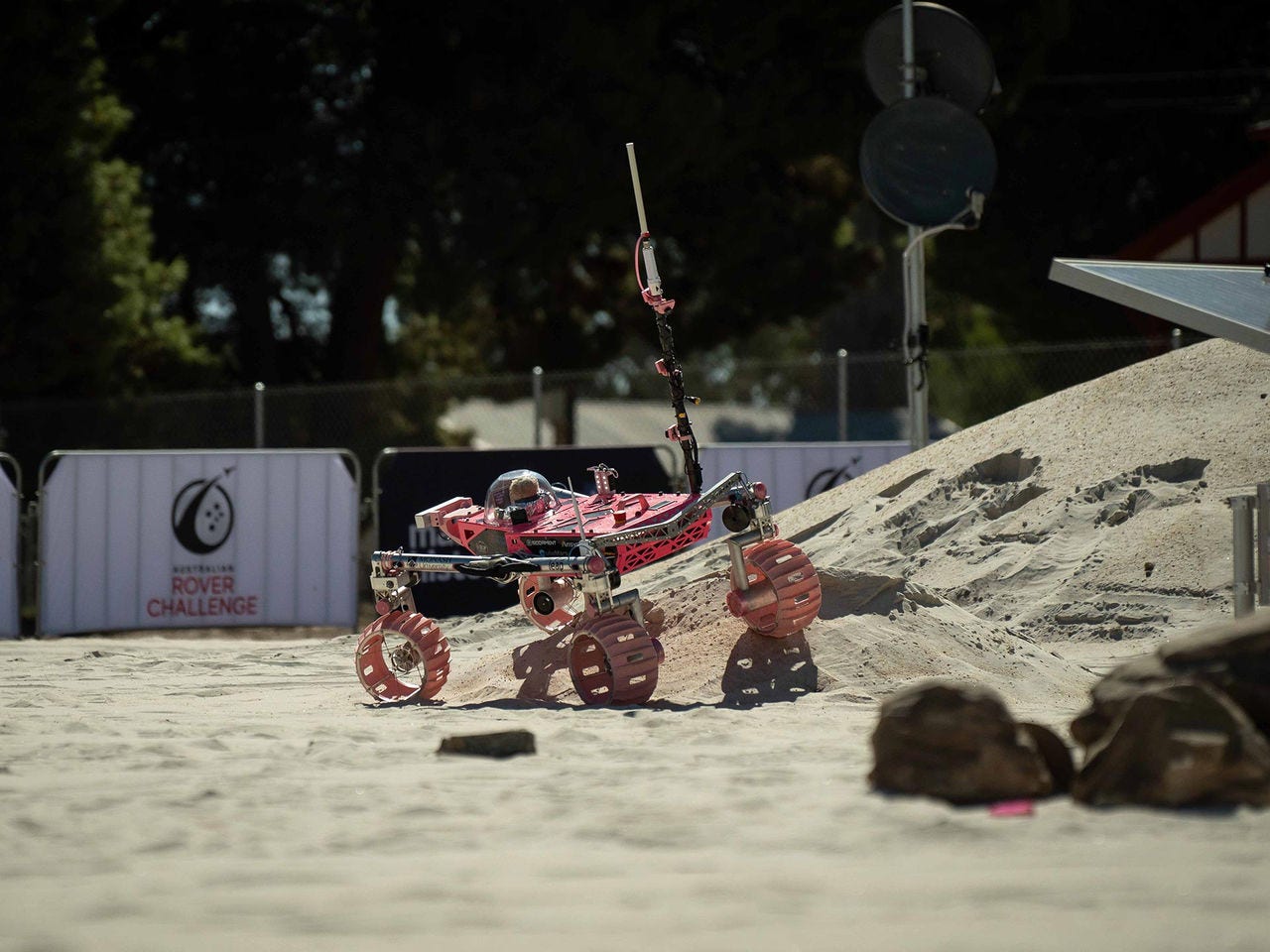

The measurement will include the antenna. This will increase the volume but will also encourage teams to think about smaller rovers, or perhaps rovers that have a smaller form factor for deployment (and measurement) then expand for operation once the task is underway.

You are certainly allowed to use your own technology in the base station (as long as it conforms to the other requirements).

You will see lots of examples of different base station set ups if you watch the streaming video from ARCh 2025 (still available from Previous challenges: Videos).

The Australian Rover Challenge is a lunar-focused rover competition and does not currently allow flying robots. You are welcome to have a micro-rover that separates from your main rover and drives separately, but a flying drone would not be permitted.

As per rule 3.17.2, we provide a recommended COTS device (see the hyperlink). The current plan is to measure the starting power during weigh-in, along with the rover size and mass, and the final power immediately at the end of the task. This way it ensures measurements are standardized across all teams and prevents cheating by recording power during the idle period from weigh-in to task start time where teams could, for example, heat-up their water extraction systems for Space Resources Task prior to the task start time and have that power not recorded.

You are permitted to use a custom power display, (as stated in Rule 3.17.2 "....or some similar alternative that allows judges to clearly record the power consumed during a task"). A team can also record power consumption and log it to a .csv using custom GUI. The starting power/voltage would correspond to the allocated start time of the weigh-in.

If you are drilling/handling lunar regolith simulant, like LHS-1 specifically purchased from a supplier like Space Resources Technologies, then there is an inhalation hazard associated with the extremely fine particle sized (<100 micron) silicates. However, if you are just drilling into sand, like the white-washed sand from Soilworx, or Bunnings, then this is the same sand you would find in a children’s sand pit and poses no risk.

The particle size distribution of these materials often contains <<1% ultra-fines which is the hazard. Also, the moment you add any water, as you would when preparing an icy sample, you neutralize any fines as they aggregate and adhere to larger particles, forming something called funicular clusters - this is the same mechanism that allows you to make sandcastles. To ensure 100% compliance, you should complete your tests in a ventilated room (i.e. with an open window or A/C).

A Vacuum System does inherently violate Rule 3.8, as it relies on an air-breathing system where negative pressure is generated through a fan acting on ambient atmospheric pressure. Although the Moon has an exosphere, it is basically a handful of molecules per metre and is on the order of 10^-12 Torr.

Similar systems have been used on the Moon before - see PlanetVac which was built by Honeybee Robotics and flew on the Firefly Blue Ghost lander this year. However, this system does not "ingest ambient air....to operate" as per Rule 3.8.  Instead, it utilises an onboard reservoir to support pneumatic operation. The use of compressed gas caries with it safety issues which you would need to explicitly and comprehensively address and accommodate. We would need to see clear safety plans outlined in your CDR / SAR submissions and approved by your university.

That interpretation is correct. This was the intention of the "or" in the original requirement.

Magenta indicates there is an error with the indicator light itself (so would be good for a timeout or error handler on the software that changes light colour), whereas red indicates an error has occurred with the rest of the rover (so beyond just a light issue).

These are deliberately left undefined (also note that the wording of this rule has not change from previous iterations of ARCh). 

It only has to be airtight when handed to the judges, this is mostly just to ensure your sample does not evaporate between the time it is collected, and the time a judge is able to measure it, which can be a period of up to several hours.

As per rule : 3.8 "rovers shall utilize power applicable to off-earth operations. Fans are allowed for the purpose of cooling the rover." In this context, fans cannot be used to promote cooling of water extraction/condensation systems, because the dissipation of heat can only occur via radiation and conduction on the Moon, the use of fans to promote convective removal of heat is not possible due to no atmosphere. As a real-world problem faced by private space companies right now, have you considered efficient passive cooling solutions? 

In Rule 10.4.1 there are 2 points are available for imaging each site (whole container + Marker). In Rule 10.4.4 there are an additional 12 points are available for providing close-up images of the sample. They are separate images each receiving separate points.

There is an element of judgement on this from the field judge. They will not penalise multiple connections with the same object as part of a move (so only one penalty if the rover front and back wheels run over something) but would record multiple penalties if the rover came back and hit the same object again.

This is deliberately not defined in the rules. It would be good if you made it so that your system could deal with different marker types.

This is a very interesting area. Ideally, teams should be operating under legal shared frequencies with legal power limits (i.e. in accordance with the LIPD class license). It should be noted however, that (as mentioned in Rule 3.12.5) we are not monitoring any of these bands. For the 900/2.4k/2.5kHz bands we are comfortable for teams to ensure they are doing sensible things themselves, and we also monitor Wi-Fi channels to help at least see when there is an issue and who is likely causing it. Our reasoning for Rule 3.12.3.2 is that UWB is starting to get a bit more outside usual operation and bespoke, and we want to further ensure teams are actually complying with the relevant regulations.

If you are operating under a public class license like LIPD, then we are happy for the approval to just be based on references to the specific license and legislation, along with evidence that your systems conform, without personalised documentation from ACMA. If you are not operating under a public class license, then we want to see more detailed evidence that you have the appropriate permits / licenses / approvals / etc. from ACMA.

We have some data that has been used mostly for promotional purposes, but it will need significant processing and adjustment before it could be shared. We would then need to very systematically share it with all teams at the same time, noting that fairness is a key part of our considerations as we answer questions and support teams. So, we do not have anything we can share right now, but it is certainly something that we are exploring for the future. We would advise collecting your own data for this work or connecting with other teams in your local area to share resources.

With regards to off-board positioning systems, we direct teams to (non-exhaustively) consider rules 3.1.2, 3.12.3, 3.13, 3.14, 3.15, and 12.4. The text as of 2026 version 1.0 is ambiguous but rule 3.13 is intended to specifically disallow to external off-board positioning that relies on satellites or transmissions outside of the team's design and control. Teams may operate their own, local off-board positioning systems, provided that:

  • it complies with rule 3.14 and does not use magnetometers;
  • it complies with rule 3.12.3 including the 3.12.3.2 provision requiring prior written permission for UWB operation; and
  • all components are either a) deployed on-pitch with the rover in accordance with rule 3.1.2 and other rules including those about status lights, E-STOPs, etc. AND/OR b) are deployed as part of the base station antenna array in accordance with rule 3.15.

As all systems must operate in a rules-compliant way either as deployable from the rover or entirely contained within the antenna zone, it is disallowed to place any kind of active or passive beacon or antenna in any other position near or on the competition pitch. There are multiple possible antenna zones for each pitch that teams may be arbitrarily directed to use, so teams must keep this in mind if designing off-board positioning systems that require use of the antenna zone. Zero consideration will be given to teams' preferences for the use of one antenna zone over another – the allocation of base stations and hence antenna zones is driven by logistical and scheduling constraints and hence is at the judges' sole discretion.

Crucially, for the mapping and autonomous task alone, due to rule 12.4, it is not allowed to use off-board positioning systems that use components within the antenna zone. This is because such a system would rely on measurements between the rover/origin and the antenna zone taken during setup, which are not provided by the judges or collected during the task time. Even if it possible to attempt to design a solution to only rely on relative range/bearing measurements from the start of the task time without initial absolute calibration, the intent of the mapping and autonomous task is to encourage development of robust, self-contained, on-board autonomy systems, and so off-board positioning using the antenna zone for this task only is explicitly disallowed. Deployable beacons or similar subsystems that begin the task with the rover are still allowed as normal, however.

The map format (2D/3D, colour/geometry, etc.) teams produce is entirely up to teams. In fact, points are explicitly awarded in the Mapping and Autonomous task presentation for this format selection and justification thereof.

The format of the provided map has varied over time and is not provided as a specified format. In 2025 it was a basic grid which included infrastructure and locations and orientations of key landmarks.

Assuming that you are using a peristaltic pump or similar, then yes it would be acceptable. If you are using a fan in a closed system, you will need to justify and explain how and why the fan is able to generate sufficient positive pressure to move the vapor. The point of Rule 3.8 is to get teams thinking about practical, real-world limitations of designing systems for the Moon where there is no atmosphere, and you can only work with radiative and conductive heating / cooling.

No, Velcro is not permitted to join pavers in ARCh 2026. This is primarily due to Velcro consisting of nylon or polyester which get blasted and degrade due to UV radiation and will clog due to lunar dust. For any solution you end up using, you need to justify to the judges that your solution is appropriate for the lunar surface (i.e. would pass a technical review board). If you are not sure, please contact the judges at auroverchallenge@adelaide.edu.au with your design and we can provide feedback before you implement it and find out its not allowed at competition.

As long as the graphic matches the ISO graphic, you may print your own stickers to adhere to the Rover. You do not need to purchase official stickers / graphics from the ISO website.

Frequently Asked Questions

Previous challenges

Want to know more about the Australian Rover Challenge? See galleries, videos and scoring information from our past challenges.

2025


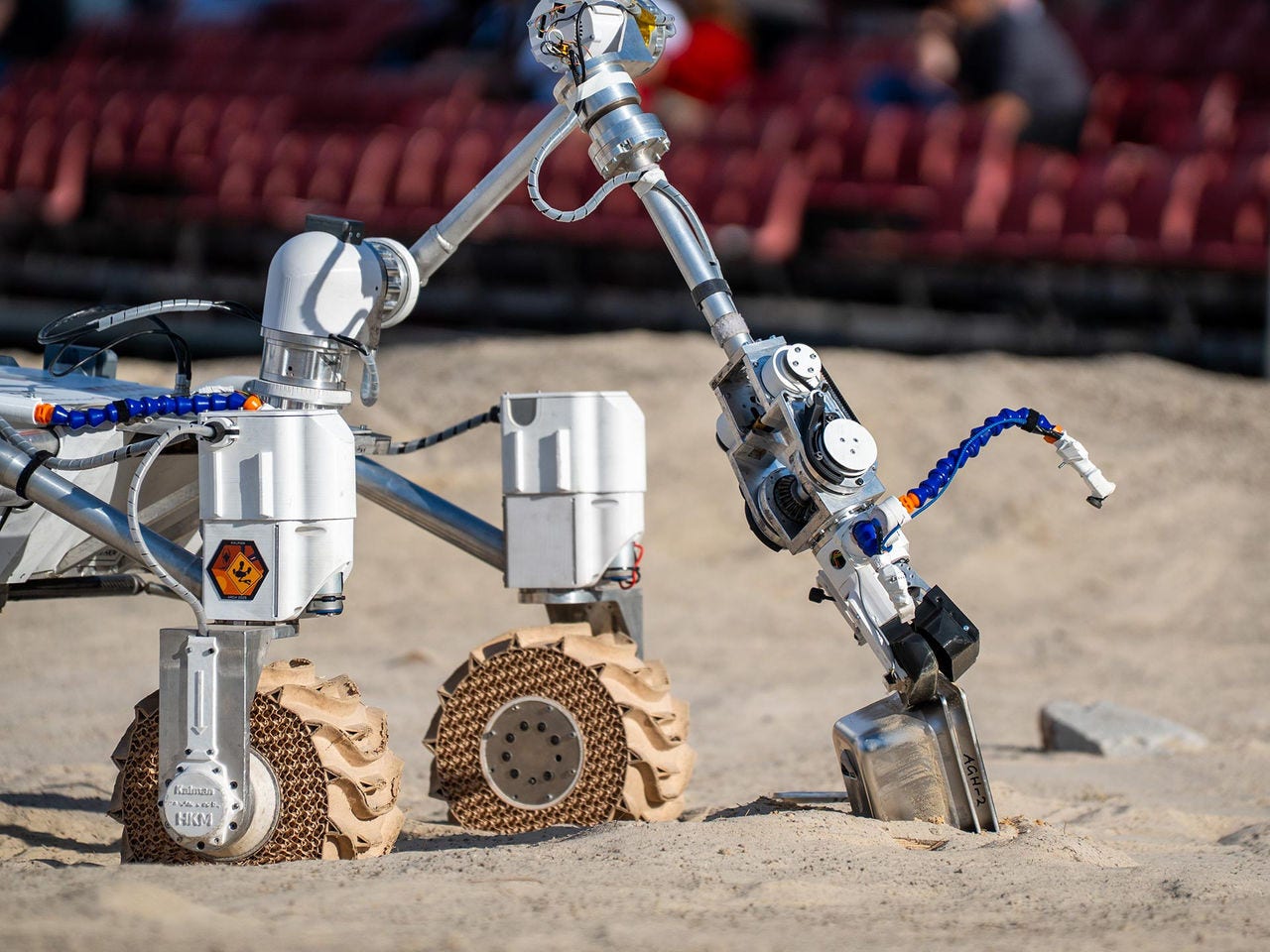
The 2025 Australian Rover Challenge marked a return to the University of Adelaide’s brand-new Exterres Analogue Facility at Roseworthy Campus. The expansion of the competition saw participants from four countries make their way to South Australia to compete in the challenge.

Well done to all our competing teams and a big congratulations to our winning teams:

  • AGH Space Systems (Kraków, Poland)
  • UQ Space (Queensland, Australia)
  • Monash Nova Rover (Melbourne, Australia)

Special thanks to our 2025 sponsors:

  • Premier Partners Caterpillar, Boeing and ELO2
  • Major partner iSpace 
  • Supporting partners Australian Space Agency and SASIC

Team name
Organisation
Country
CDRSAR
Post
Landing
Task

Excavation &
Construction
Task

Space
Resources
Task

Mapping &
Autonomous
Task
Total
Score
AGH Space Systems
AGH University of Kraków
Poland
21.654.0901007680421.6
UQ Space
The University of Queensland
Australia
22.355.3851008333378.6
Monash Nova Rover
Monash University
Australia
26.862.065926845358.8
Legendary Rover Team
Rzeszów University of Technology
Poland
16.459.1908927.437.4319.3
Project Scorpio
Wrocław University of Science and Technology
Poland
20.357.055567133292.3
Robotics and Autonomous Systems (RAS) Team UNSW Canberra
UNSW Canberra
Australia
22.759.67071.83035289.1
QUT Remote Off-world Autonomous Robotics (R.O.A.R.)
QUT
Australia
23.255.170702829275.3
UOW Rover Team
University of Wollongong (UOW)
Australia
20.249.05056.22546246.4
UniMelb Rover Team
The University of Melbourne
Australia
23.154.458.549.225.59219.7
Adelaide Rover Team
The University of Adelaide
Australia
23.852.720702913208.5
RMIT Rover Team
RMIT University
Australia
19.449.2303343.815190.4
UTS ROCK-E THE ROVER
University of Technology Sydney
Australia
21.250.04.52642.49153.1
Deakin Rover Team
Deakin University
Australia
17.848.427 26 119.2
Bluesat
University of New South Wales
Australia
22.149.90911 92.0
UWA Rover Team
University of Western Australia
Australia
15.543.44 161290.9
Swinburne Rover Team
Swinburne University
Australia
22.347.5    69.8
NU Rover Team
Nazarbayev University
Kazakhstan
18.347.1    65.4
Macquarie Aerospace Rover Society (MARS)
Macquarie University
Australia
18.834.1    52.9
KNR Rover Team
Warsaw University of Technology
Poland
20.1     20.1
SKA Robotics
Warsaw University of Technology
Poland
19.4     19.4
Rhino Rover
Dayananda Sagar Academy of Technology and Management
India
14.5     14.5
Team Kosmos
NMIMS MPSTME
India
12.6     12.6
UC01
University of Canberra
Australia
10.1     10.1
Team Atlas
Team Atlas
Bangladesh
9.1     9.1

Tasks

The Australian Space Agency Post-Landing Task

Your Rover has just landed on the surface of the Moon. Your team is now required to execute a task list to work towards establishing an in-situ resource utilization (ISRU) outpost. Tasks include: conduct a systems check on the lander and relay any damage to the judges, navigate to and find the location of the Supply Caches while traversing past obstacles and initiate a start-up protocol, download instructions and perform maintenance, connect propellant hoses.

iSpace Space Resources Task

Towards the goal of supporting future astronauts which need breathable oxygen, potable water and construction materials, your rover must begin the evaluation, collection and extraction of critical lunar resources including frozen volatiles like H2O, and metals like Ti and FeO from ilmenite (FeTiO3). To do this, your rover has two primary tasks to perform; 1) in-situ resource prospecting, 2) then excavate and process the target resource to hand to judges. There will be two types of resource deposits your rover must investigate: dry partially magnetic soil representing ilmenite-enriched regolith, and frozen ice-cemented soil representing deposits of frozen volatiles in Persistently Shadowed Regions (PSRs).

ELO2 Excavation & Construction Task

Rovers are expected to scale-up operations and prepare the site for a future human landing by conducting some foundation services which include removing hazards by clearing rocks, excavating and transporting regolith to construct a berm, and constructing a feature of the team's choosing using dust-mitigating pavers brought from Earth

​​​​​​​​​​​​​​Boeing Mapping & Autonomous Task

Rovers need to explore a new area given a rudimentary map, perhaps derived from data collected by orbiters. This map will contain a series of landmarks that scientists are interested in imaging in more detail, and the rover will need to navigate to these without human intervention. Then, either autonomously or under operator control, a larger-scale map of the arena will need to be constructed, and the locations of previously unknown landmarks will need to be determined.​​​​​​​

Daily action of the 2025 Australian Rover Challenge

2024


The 2024 Australian Rover Challenge was an exciting new chapter in evolution of the competition, moving to the University of Adelaide’s brand-new Exterres Analogue Facility at Roseworthy. The expansion of the competition saw over 210 participants from three countries making their way to South Australia as well as almost 6,500 daily streams logging-on to watch the competition from all around the world making this the largest ARCh yet. 

Well done to all our competing teams and a big congratulations to our winning teams:

  • Projekt Scorpio (Wrocław, Poland)
  • Monash Nova Rover (Melbourne, Australia)
  • UQ Space (Brisbane, Australia)

The move to the larger arena demonstrated just how challenging mobility, navigation and perception on the lunar surface can really be. Rising to the challenge, teams were ready and able to showcase their rover’s functionality as well as the perseverance and adaptability of their team members.

It was a great pleasure for ARCh to host the teams in 2024 and we were thrilled to see another increase in participant numbers, both in the design rounds and during the final competition days. With 2024 seeing new teams from around Australia and the globe along with growth in the returning teams - the ARCh organising committee is looking forward to seeing what the 2025 competition holds.

Special thanks to our 2024 sponsors:

  • Premier Partners Boeing and ELO2
  • Major partners iSpace and the Australian Space Agency
  • Supporting Partners, SASCIC and Caterpillar
  • Event Supporters CSIRO and Mini Mammoth Games

CountryCDRSARPost
Landing
Task
Excavation &
Construction
Task
Space
Resources
Task
Mapping &
Autonomous
Task
Total
Score
Project Scorpio
Wrocław University of Science and Technology
 Poland
20.456.885609239353.2
Monash Nova Rover
Monash University
 Australia
24.161.156436828.8281.0
UQ Space
University of Queensland
 Australia
24.156.245426130258.3
QUT Robotics Club
Queensland University of Technology
 Australia
22.457.96042.73420237.0
Adelaide Rover Team
University of Adelaide
 Australia
19.862.542.52429.717195.5
UniMelb Rover Team
University of Melbourne
 Australia
22.256.24512348.5177.9
RMIT Rover Team
Royal Melbourne Institute of Technology
 Australia
20.351.202956.613170.1
Swinburne Rover Team
Swinburne University of Technology
 Australia
17.852.452225.2   122.4
Team Atlas
Brac University
 Bangladesh
13.236.4016.526092.1
UOW Rover Team
University of Wollongong
 Australia
16.842.5010.2      69.5
REV
University of Western Australia
 Australia
16.347.5            63.8
SHUNYA
Indian Institute of Information Technology,
Design & Manufacturing
in collaboration with
Madras Christian College
 India
21.3               21.3
UTS Rover Team
University of Technology Sydney
 Australia
21.2               21.2
KMC Robophysicists
University of Delhi
 India
12.3               12.3

Tasks

The Australian Space Agency Post-Landing Task

Your Rover has just landed on the surface of the Moon. Your team is now required to execute a task list to work towards establishing an in-situ resource utilization (ISRU) outpost. Tasks include: conduct a systems check on the lander and relay any damage to the judges, navigate to and find the location of the Supply Caches while traversing past obstacles and initiate a start-up protocol, download instructions and perform maintenance, connect propellant hoses.

iSpace Space Resources Task

Towards the goal of supporting future astronauts which need breathable oxygen, potable water and construction materials, your rover must begin the evaluation, collection and extraction of critical lunar resources including frozen volatiles like H2O, and metals like Ti and FeO from ilmenite (FeTiO3). To do this, your rover has two primary tasks to perform; 1) in-situ resource prospecting, 2) then excavate and process the target resource to hand to judges. There will be two types of resource deposits your rover must investigate: dry partially magnetic soil representing ilmenite-enriched regolith, and frozen ice-cemented soil representing deposits of frozen volatiles in Persistently Shadowed Regions (PSRs).

​​​​​​​ELO2 Excavation & Construction Task

Rovers are expected to scale-up operations and prepare the site for a future human landing by conducting some foundation services which include removing hazards by clearing rocks, excavating and transporting regolith to construct a berm, and constructing a feature of the team's choosing using dust-mitigating pavers brought from Earth

​​​​​​​​​​​​​​Boeing Mapping & Autonomous Task

Rovers need to explore a new area given a rudimentary map, perhaps derived from data collected by orbiters. This map will contain a series of landmarks that scientists are interested in imaging in more detail, and the rover will need to navigate to these without human intervention. Then, either autonomously or under operator control, a larger-scale map of the arena will need to be constructed, and the locations of previously unknown landmarks will need to be determined.

Australian Rover Challenge 2024
Daily action of the 2024 Australian Rover Challenge

2023


What a massive four days of the 2023 Australian Rover Challenge (ARCh)!

This year saw eight teams of over 180 student participants, including the Projekt Scorpio team all the way from Poland, join in the competition!

Well done to our winning teams:

  • Monash Nova Rover (Melbourne, Australia)
  • Projekt Scorpio (Wrocław, Poland)
  • University of Melbourne Rover Team (Melbourne, Australia)

Shout out also to the Adelaide Rover Team for taking home Best Team Culture, and Queensland University of Technology Robotics Club (QUTRC) for scoring Best New Team!

Our favourite part of the ARCh is the camaraderie and community between the team workshop tents, with countless stories of large and small acts of kindness when a critical rover part fails.

It's incredible to see so many new and growing Australian (and international!) teams coming to Adelaide to showcase their capabilities in developing and operating their rovers.

Special thanks to our sponsors:

  • Premier partner Boeing
  • Major partners ispace and the Australian Space Agency
  • Event supporters Defence SA, SASIC and Drone Deploy

If you missed the action, you can still check out the livestream recordings.

Team nameUniversityCountryCDRSARPost LandingExcavation ConstructionSpace ResourcesMapping AutonomousTOTAL
Monash Nova RoverMonash UniversityAustralia20.465.79072.746.540335.3
Project ScorpioWroclaw University of Science and TechnologyPoland1738.88055.65463308.4
UniMelb Rover Team (URT)University of MelbourneAustralia15.950.5756.0510198.4
QUTRC ArtemisQueensland University of TechnologyAustralia19.739.5604.51220155.7
UQ Space Inc.University of QueenslandAustralia23.154.14.54.3519146.0
Adelaide Rover TeamUniversity of AdelaideAustralia20.548.2184.946.50138.1
UTS Rover TeamUniversity of Technology SydneyAustralia12.053.004.542.50112.0
RMIT Rover TeamRoyal Melbourne Institute of TechnologyAustralia13.434.100.633.5081.6

Tasks

The Australian Space Agency post-landing task

Your Rover has just landed on the surface of the Moon. Your team is now required to execute a task list to work towards establishing an in-situ resource utilization (ISRU) outpost. Tasks include: conduct a systems check on the lander and relay any damage to the judges, navigate to and find the location of the Supply Caches while traversing past obstacles, and initiate a start-up protocol.

The ispace space resources task

To demonstrate its ability to conduct foundation services, Rovers are expected to  perform in-situ resource identification and processing of icy lunar regolith (extraterrestrial soil) to determine which unexplored sample site may yield the greatest amount of frozen water, and to extracted as much water as possible to support human life-support systems and refuelling of spacecraft.

The construction and excavation task

Your rover is expected to conduct a variety of activities on the lunar surface including the extraction, transport and deposition of dry lunar regolith in an ISRU hopper, as well as performing surface preparations including terrain assessment, shaping and/or debris clearing, and interacting with or deploying artificial structures.

The Boeing mapping and autonomous task

Your rover is required to map the area and traverse autonomously in support of establishing a sustainable, long-duration ISRU base.

Australian Rover Challenge 2023
Daily action of the 2023 Australian Rover Challenge

2022


This year's challenge saw Australian university students building, operating and competing their semi-autonomous rovers in a simulated lunar environment, accomplishing navigation, resource utilisation, and construction tasks while assisted and mentored by international industry and government partners.

The rovers attempted In-situ resource evaluation, performed semi-autonomous tasks and interacted with the environment using a robotic arm. In addition to the physical challenge, students presented their rover designs to industry professionals, academia and Australian Rover Challenge judges. 

After three sunny days on the Maths Lawn at the University of Adelaide's North Terrace camps, the students completed their four challenges while entertaining spectators for the top spot. The results were:

  • Winner – Monash University 
  • Runner up – University of Melbourne
  • Best team culture – UTS

Congratulations to our other participants, University of Adelaide and University of Queensland.

Thank you to all of our student participants and our industry partners and sponsors for such an exciting competition!

After the marking of the Preliminary Design Review, teams were given a score out of 15 Challenge points. The top three teams and their scores are listed below.

  • Monash Nova Rover - Monash University 13.6
  • RMIT Rover Team - RMIT University 12.0
  • Adelaide Rover Team - The University of Adelaide 11.6

After the marking of the System Acceptance Review, teams were given a score out of 25 Challenge points. The top three teams and their scores are listed below.

  • Monash Nova Rover - Monash University 22.3
  • Adelaide Rover Team - University of Adelaide 19.3
  • UQ Space - University of Queensland 18.4

The top three teams after the reporting deliverables out of 40 Challenge points are listed below.

  • Monash Nova Rover - Monash University 35.9
  • Adelaide Rover Team - University of Adelaide 30.9
  • UQ Space - University of Queensland 28.7

Australian Rover Challenge 2022
Information recording sessions
Webinar and Q&A session - 25 August 2021: On Wednesday 25 August 2021, the Australian Rover Challenge Organising Committee hosted a webinar and Q&A session.
Webinar and Q&A session - 6 October 2021: In this second ARC 2022 webinar, the ARC Organising Committee addressed changes and elaborations to the ruleset. Featuring the ARC judges David Harvey and Rini Akmeliawati, as well as ARC Organisers and Rules Developers, Daniel Ricardo and Henry Lourey.
Webinar and Q&A session - 14 December 2021: The ARC organising committee discuss the recently released System Acceptance Review (SAR) and Distributed Field Test (DFT) requirements document, and answer questions from attendees.

2021


The challenge was for students to design, build and operate their semi-autonomous rover in a simulated lunar environment. Put to the test, the rovers had to conduct In-situ resource evaluation, perform semi-autonomous tasks and interact with the environment using a robotic arm. In addition to the physical challenge, students presented their rover designs to industry professionals, academia and Australian Rover Challenge judges.

After two (mostly) sunny days on the Maths Lawn at the University of Adelaide's North Terrace camps, the students completed their four challenges while entertaining spectators for the top spot. The results were:

  • 1st place – Monash University 
  • 2nd place – RMIT
  • 3rd place – The University of Adelaide 

We also asked each team to select their Most Valuable Team member – this award recognises the individual’s contribution to the team and going over and above to help the team during the lead up to and during the competition. The following were selected:

  • Will De La Rue – Monash University 
  • Dave Tucker – RMIT 
  • Abigail Sparnon – The University of Adelaide 

Thank you to all of our student participants and our industry partners and sponsors for such an exciting competition!

The Australian Rover Challenge partnered with the South Australian Space Industry Centre (SASIC) and was supported by the Australian Space Agency and the SmartSAT CRC.

Australian Rover Challenge 2021

Partner with us

The Australian Rover Challenge is the premier platform to showcase Australian student talent and capability in space activities, and creates downstream opportunities for outreach and student engagement to inspire other young people to take up STEM educational pathways.

Partnership opportunities

Partnership options could include:

  • Financial hardship contributions for students who are unable to finance travel to and accommodation for the Challenge in Adelaide (3-4 nights)
  • Funding material and props to build the Challenge arena – including sponsoring one of the 4 Rover tasks over the 2-day competition
  • Australian Rover Challenge Opening Event Sponsor
  • Australian Rover Challenge Closing event sponsor
  • Funding team and judging panel marquees
  • Funding prizes for future Challenge awards

Why partner with the Australian Rover Challenge?

In supporting Australian Rover Challenge, there are several opportunities for brand recognition and involvement. Depending on the goals of your organisation, this could include:

  • Sponsoring of unique prizes (best documentation, most innovative, most improved, etc.)
  • Opportunities to present a seminar for competing teams
  • Participating as a Judge to review student technical reports and/or the Challenge tasks
  • Providing technical knowledge seminars/workshops for student teams
  • Promoting information about your company and how students may apply for graduate pathways or internships
  • General Challenge advocacy

Expressions of interest

Contact us if you are interested in becoming a partner.
Partner with us

Contact us

If you would like more information or require technical assistance, please use the form below to contact the ARCh Organising Committee.
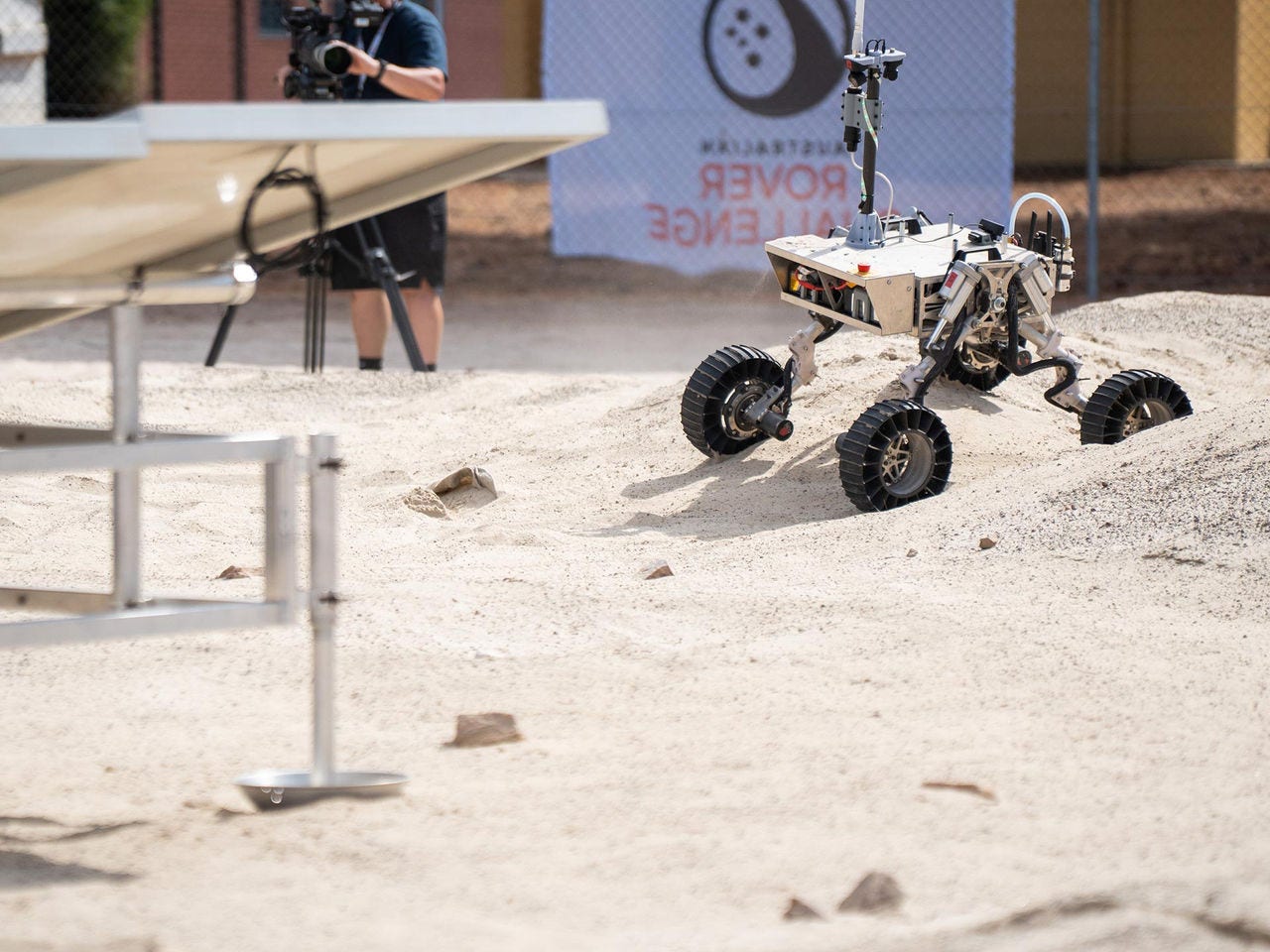
Contact us

The mission: About the Australian Rover Challenge

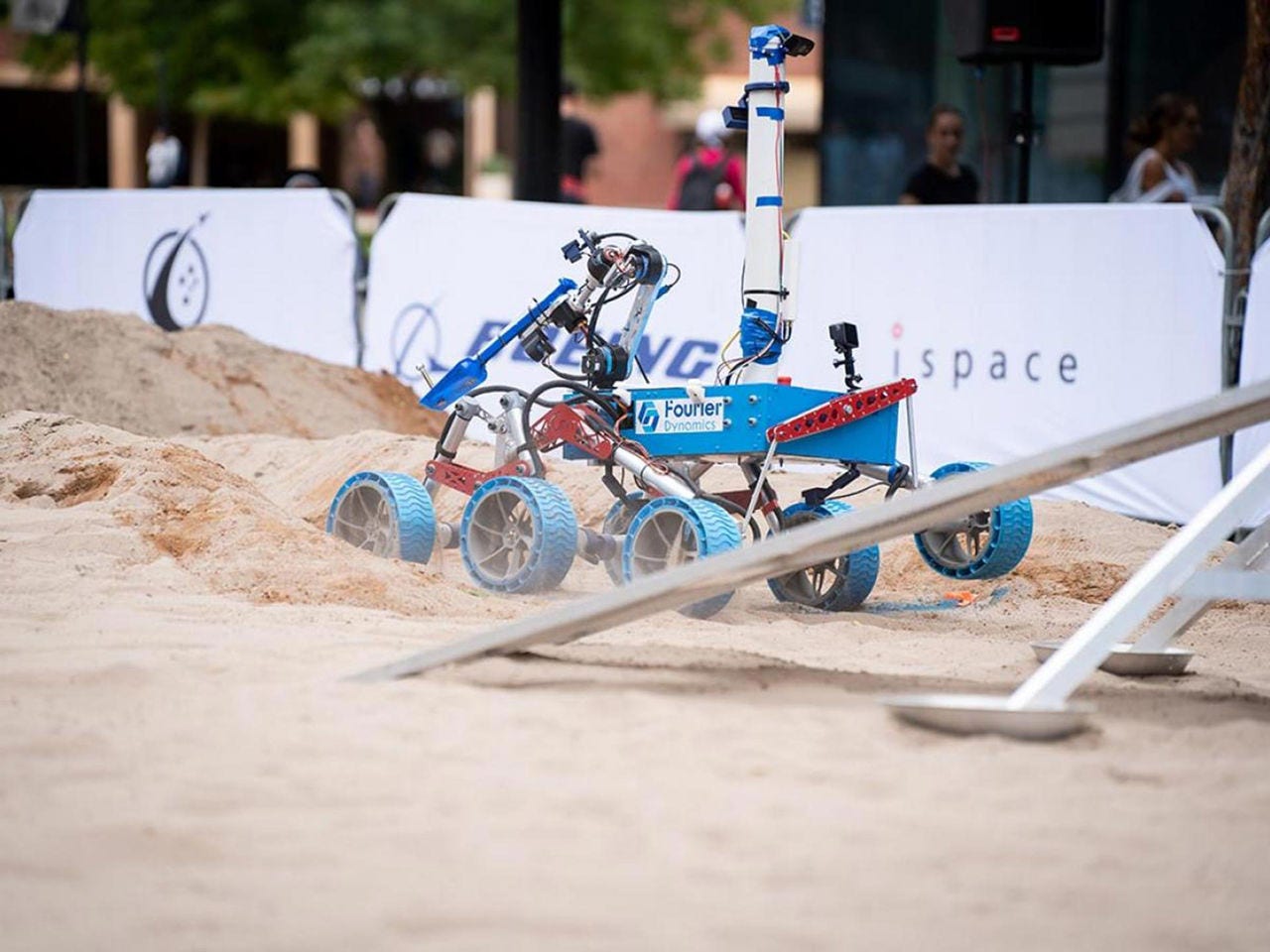
The Australian Rover Challenge (ARCh) is an annual robotics competition held by the University of Adelaide, where university students from across Australia and around the globe, battle it out in a full-scale Lunar mission, using semi-autonomous rovers that they have designed and built themselves.

Competitors showcase their skills in a custom built simulated lunar environment, and complete a range of tasks including navigation, resource, and construction. Unlike many other rover competitions across the world which focus on Martian exploration, the ARCh is focused specifically on completing tasks on a simulated Lunar surface.
The mission: About the Australian Rover Challenge

Australian Rover Challenge 2026 partners

Premier partners

Event supporters

Challenge arena materials partner